Home › Guides › How to convert
Guide · updated October 27, 2026
How to convert a golf cart to lithium, step by step
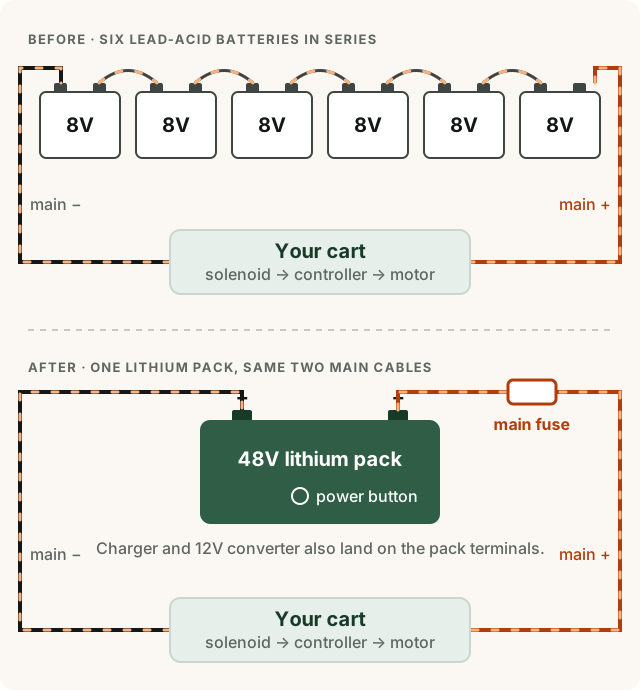
Converting a golf cart to lithium means replacing its six or four lead-acid batteries with one lithium pack of the same voltage. Here is the whole job in 10 steps. Your kit's manual always comes first.
- An afternoonTime
- ModerateDifficulty
- 2 main cablesTo connect
- $0 laborIf you do it yourself
Do it yourself if you keep the same voltage and the kit is made for your cart. Call a shop if you change the voltage or have an ICON.
1. Before you buy: three checks
- Same voltage. Count the batteries under the seat and read one label: six 6V = 36V; six 8V or four 12V = 48V. Your lithium pack must match.
- A kit made for your cart. Battery bays and plugs change with the brand and the year. Find your cart to see the kits that fit it.
- What's in the box. Charger, 12V converter, bracket, main fuse: many kits leave one out. Each kit page lists what's included.
2. What you need
- The lithium pack, its lithium charger and the bracket made for your cart.
- A main fuse or breaker for the positive cable, if the kit doesn't include one.
- A 12V converter if you have lights, a horn, a radio or USB ports.
- Wrenches, a torque wrench, gloves, safety glasses, wheel chocks, and baking soda and water for the tray.
3. The swap in 10 steps
Take a photo of the wiring
From above, so you know where every cable went.
Make the cart safe
Key off, Run/Tow switch on TOW, wheels chocked, rings and watch off.
Disconnect the old batteries
Main negative cable first, then the main positive, then the short cables between batteries. Remove any small wire tapped off a single battery (old 12V reducer, lights). Careful Never start with the positive cable.
Lift the batteries out
One at a time, with a strap or a helper: each weighs 60 to 70 lb.
Clean the tray
Baking soda and water, then dry it and check it for rust.
Set the pack in place
Secure it with the kit's bracket: it must not slide or tip.
Connect the pack
With the pack switched off: positive first (through the main fuse), negative last. Tighten to the torque in your kit's manual. Careful Not the lead-acid torque value.
Wire the 12V converter
Through its fuse. Lights and accessories go on the converter. Careful Never wire 12V lights straight to the pack.
Set up charging
The lithium charger and plug, plus the one step specific to your cart (see below).
Power up and test
Press the pack's power button, wait about 30 seconds, switch to RUN and turn the key. Drive slowly and check that the terminals stay cool.
4. The one step that depends on your cart
- Club Car DS, Precedent
- Older carts have an onboard computer (OBC) that controls charging. Some kits bypass it, others don't need to: do what your kit says. DS page · Precedent page
- E-Z-GO TXT, RXV
- A small wire in the charge port tells the cart it's unplugged. Left loose, the cart won't move: reconnect it as your kit shows. On an RXV, pick a pack made for its regenerative braking. TXT page · RXV page
- Yamaha Drive, Drive2
- The charge plug changes with the year, and AC Drive2 carts brake regeneratively like an RXV. Drive2 page
- ICON
- The controller has to be reprogrammed. Leave this one to a dealer or a golf cart shop. ICON page
- Factory lithium carts
- Club Car Tempo/Onward Lithium and E-Z-GO ELiTE already run on lithium: no conversion kit fits them.
5. After the swap
- Charge it full once before a long trip: packs often ship half charged, and the meter learns on that first charge.
- Use the kit's meter, not the old gauge. The old gauge reads lithium wrong and can drop from half to empty at once.
- In winter, store it partly charged and switched off, and don't charge below freezing unless the pack is self-heating.
Something not right? See troubleshooting by symptom.
What we check for you
- Fit. Every kit is checked against your cart's battery bay — confirmed by the brand or by size — with the source.
- Power. We flag packs that may cut out on hills with your cart's controller.
- What's in the box. Charger, 12V converter and charge meter are listed on every kit, so nothing is missing on install day.
- Warranty. The exact length and conditions from the brand, on every kit page.
Before you order: check the seller's return policy, and favor a brand you can reach by phone.
Steps checked against the installation manuals and guides of Epoch, Fleet Lithium, Allied Lithium, BigBattery, Dakota Lithium and Lithium Rhino, and against owner reports on golf cart forums such as Cartaholics. Recycling rate: Battery Council International (2026). Kit data checked October 25, 2026. This guide is general information, not a substitute for your kit's manual or a golf cart technician.